Others ask to be felt.
Lamu Archipelago does not rush to impress you. It does not announce itself with skyscrapers or highways or neon lights. It arrives softly — in the hush of ocean wind through carved wooden shutters, in the distant echo of the call to prayer, in the rhythm of donkey hooves on coral-stone pathways polished smooth by centuries of footsteps.

This is not simply a place you visit.
It is a place you surrender to.


For four extraordinary days, the Lamu Cultural & Island Heritage Tour invites you into a world where East Africa’s oldest Swahili settlement still breathes exactly as it has for generations — slow, poetic, salt-kissed, and timeless.
Day One: Arrival in a Different Century
The journey begins in the sky.
A short flight from Nairobi or Mombasa lifts you above Kenya’s changing landscapes until the mainland dissolves into scattered islands and brilliant turquoise channels.
Then comes your first glimpse of Lamu.
Whitewashed rooftops shimmer under the sun. Wooden dhows drift lazily across still waters. The Indian Ocean sparkles like polished glass.
Landing at Manda Airport feels less like arriving at an airport and more like stepping into another era.
There are no taxis waiting.
No traffic horns.
Instead, a wooden boat glides silently across the channel, carrying you toward the historic waterfront of Lamu Old Town.
And then it happens:
The modern world slips away.
A Town Built for Wandering
Lamu is one of the oldest continuously inhabited Swahili settlements in East Africa and a celebrated UNESCO World Heritage Centre site.
Its streets are too narrow for cars.
Transport here belongs to donkeys, dhows, and footsteps.
As you wander coral-stone alleyways, every turn reveals another masterpiece of Swahili architecture:
- Towering intricately carved teak doors
- Hidden inner courtyards scented with jasmine
- Weathered balconies leaning toward the sea
- Quiet mosques rising above whitewashed walls
The town feels alive with memory.
It whispers stories of Persian traders, Arab sailors, African scholars, and centuries of commerce that shaped the Swahili coast.
You do not merely walk through history here.
You walk inside it.
The Living Soul of Swahili Culture
Unlike many heritage destinations preserved as museums, Lamu still lives its traditions daily.
Morning markets hum with merchants selling spices and woven baskets.
Artisans carve furniture using techniques passed through generations.
Women in flowing buibuis move gracefully through narrow lanes.
Children race beside donkeys carrying fresh produce.
At the historic Lamu Fort and Lamu Museum, your guide reveals how trade routes connected this island to Arabia, Persia, India, and inland Africa for centuries.
Nearby, the spiritual atmosphere of the Riyadha Mosque speaks to Lamu’s enduring place as a center of Islamic scholarship and Swahili learning.
This is heritage not behind glass — but woven into everyday life.
The Taste of the Coast
To know Lamu is to taste it.
Meals here tell stories of centuries of cultural exchange.
You will savor dishes layered with coconut, cardamom, cinnamon, tamarind, and fresh seafood pulled from surrounding waters.
Expect unforgettable Swahili classics such as:
- Coconut fish curry
- Pilau rice infused with warming spices
- Freshly baked mahamri
- Tamarind juices
- Delicate seafood biryanis
Every meal is an inheritance passed down through generations.
And every bite tastes of the ocean.
Day Three: Sailing into Silence
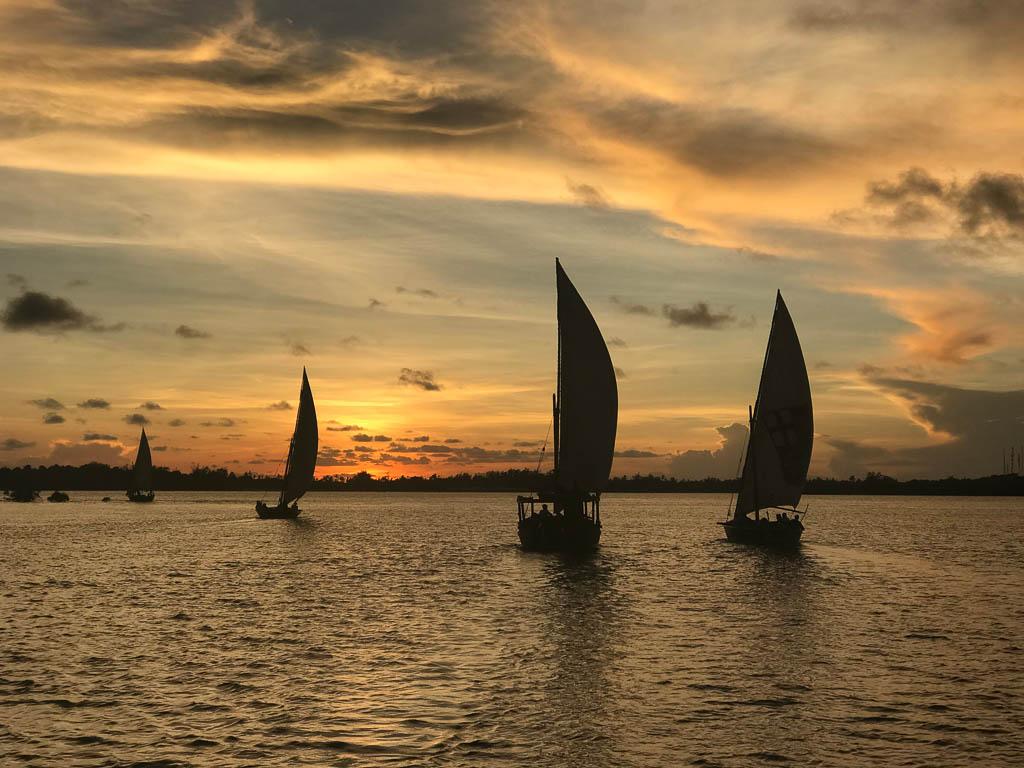
There is perhaps no image more iconic to Lamu than the traditional dhow.
These handcrafted wooden sailing vessels have crossed the Indian Ocean for centuries, guided only by wind and tide.
Aboard one, time moves differently.
Lamu Channel opens before you in endless blue as your sail catches the breeze.
The shoreline drifts quietly past.
The sea whispers against timber.
No engines.
No urgency.
Only motion.
It is one of Africa’s most peaceful travel experiences.
The Forgotten City of Takwa
On Manda Island lies one of Kenya’s most haunting historical treasures: the ancient Takwa Ruins.
Hidden among mangroves and wind-blown silence, these 15th-century Swahili ruins tell the story of a once-thriving settlement mysteriously abandoned centuries ago.
Stone mosques stand roofless beneath open sky.
Ancient wells remain carved into coral rock.
Walls weathered by salt and time still hold their dignity.
Walking here feels like stepping into memory itself.
It is one of the most atmospheric archaeological sites on the East African coast.
Shela: Where the Ocean Exhales
Then comes Shela Beach.
Long, soft, and endlessly peaceful, it is among Kenya’s most beautiful stretches of coastline.
No crowds.
No noise.
Just dunes, sea breeze, and impossible stillness.
Here you can:
- Walk barefoot for miles
- Climb the golden sand dunes at sunset
- Read beneath swaying palms
- Swim in warm turquoise waters
- Watch dhows drift across the horizon
It is not the kind of beach that entertains.
It is the kind that restores.
Why Lamu Changes You
Travel often fills us with excitement.
Lamu fills us with stillness.
It teaches patience.
It reminds us that beauty does not need spectacle.
That culture deepens when it is lived slowly.
That some of the world’s greatest luxuries are silence, sea breeze, and time.
This is why travelers return again and again.
Not to see more.
But to feel more deeply.
The Island That Refuses to Hurry
Four days in Lamu will feel strangely longer than weeks elsewhere.
Because here, time expands.
The clocks matter less.
The tides matter more.
And somewhere between the call to prayer at dawn and the final glow of sunset over the dhow-lined channel, you begin to understand why Lamu has enchanted travelers for centuries.
It is not trying to impress you.
It is simply being itself.
And that is unforgettable.
Lamu is not a destination on your itinerary.
It becomes a memory your soul quietly returns to forever.